 Blox
How to play Blox
Everything you need to know: the controls, the goal, every kind of tile, how points work, and how to find the shortest path.
The goal
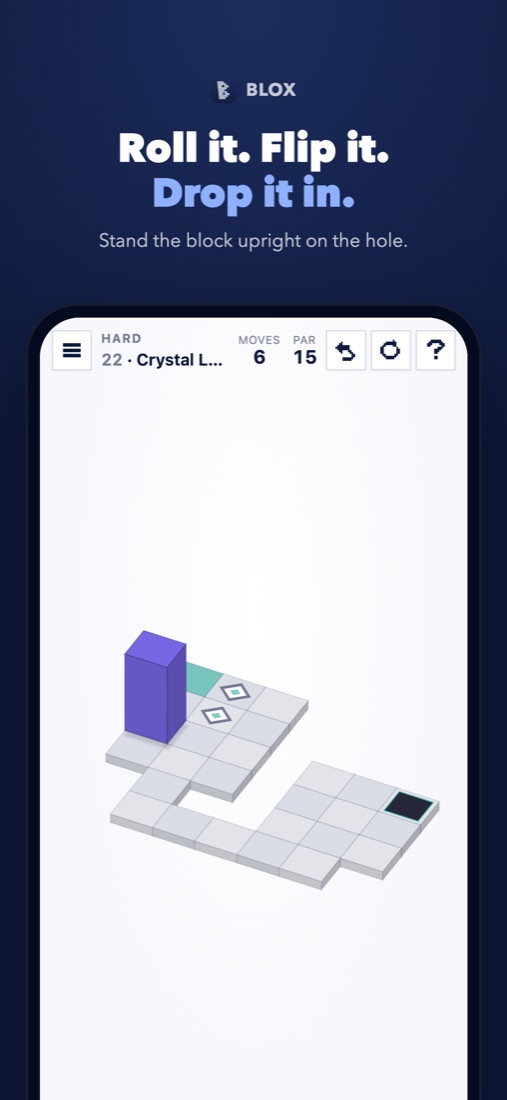
You control a block that is two cubes tall: a 1×1×2 brick. Each level is a small floating board with one dark square hole in it. Roll the block across the board and stand it upright on the hole so it drops through. That's it. If any part of the block hangs over the edge, it falls and you start the level again.
Getting to the hole is the easy part. Getting there in the fewest possible moves is the real puzzle, and it is what earns you a perfect 10.
Controls
- Phone or tablet: swipe in the direction you want to roll. Swipes follow what you see on screen, so swipe toward the tile you want to reach. You can also use the on-screen direction pad.
- Keyboard: the arrow keys or W A S D roll the block. Z undoes a move, R restarts, H shows a hint.
- Two cubes: when the block has split in two, tap the board (or press Space) to switch which cube you are moving.
How the block rolls
The block has three ways to sit: standing upright on one tile, or lying down across two tiles (pointing either across or along the board). Every roll tips it over an edge:
- Standing up, one roll lays it flat. It now covers the next two tiles in that direction.
- Lying flat, rolling along its length stands it back up on the far side.
- Lying flat, rolling sideways keeps it flat and moves it over by one tile.
That is why a hole two tiles away can take more moves than one five tiles away: you have to arrive standing up. Upright moves cover ground fast (each one travels three tiles' worth in two rolls), while sideways rolls let you shuffle one tile at a time.
Tiles and mechanics
Each tier introduces something new. Here is every tile you will meet, with a tip for each.
Cracked tiles
Pale rose glass with white cracks. They hold a lying block, but an upright block puts all its weight on one tile and breaks straight through.
TIPPlan your route so you always cross cracked tiles lying down. Count ahead: where will you be standing two moves from now?
Touch pads
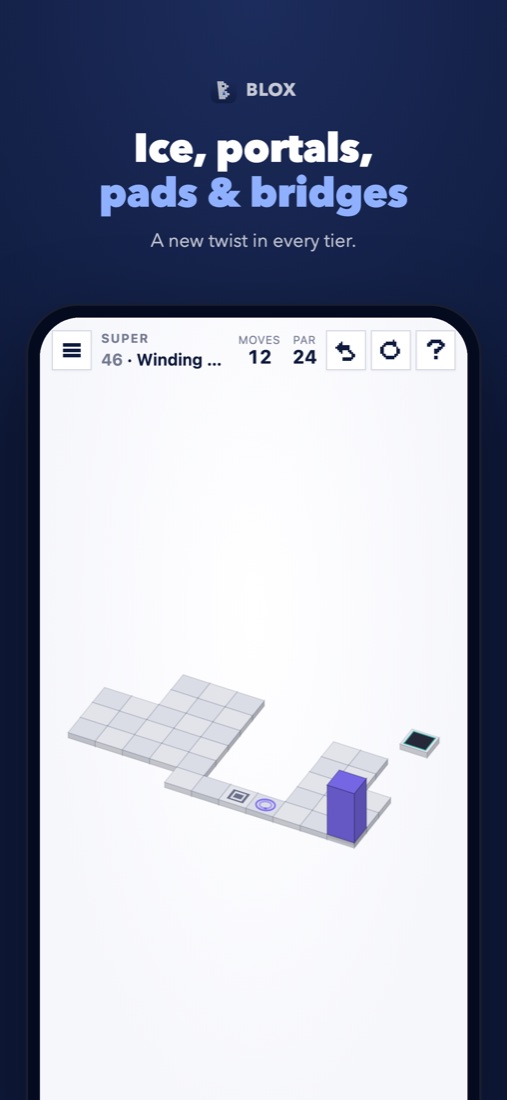
A diamond-shaped pad. Any part of the block touching it, standing or lying, toggles the bridges linked to it. Bridges appear in teal and fill gaps in the board.
TIPTouch pads toggle, so touching one twice can close the bridge you just opened. Watch the bridges after every press.
Press plates
A solid square plate. It needs weight: only an upright block presses it. Rolling over it lying down does nothing.
TIPWork backwards from the plate: you need to land on it standing, so line up the move before it.
Ice
A block resting fully on ice keeps sliding in the direction it was going until it reaches normal floor or something stops it, or it slides off the edge.
TIPA slide is one move no matter how far it goes. Ice is often the fastest way across a level, if you enter it from the right place.
Conveyors
Arrow tiles push the block one tile in their direction when it rests fully on them, and keep pushing while it lands on more arrows.
TIPThe push is part of the roll that put you there, so it costs no extra moves. Use conveyors to reposition yourself without spending moves.
Portals
Rings that come in pairs. Stand upright on one ring and you warp to its twin.
TIPLying across a ring does nothing, so you can cross a portal without using it.
Crumbling floor
Dotted tiles that hold you once. The moment you roll off them, they fall away.
TIPEvery crumbling tile is a one-way door. Make sure you won't need to come back through it.
Blinking floor
These tiles switch on and off with every move you make, wherever the block is on the board.
TIPCount your moves so you land on a blinking tile when it is solid. Sometimes one extra sideways roll is the cheapest way to get the timing right.
Color floors and paint pads
Tinted floor only holds a block of the same color. Roll over a paint pad to recolor your block.
TIPPlan the order: pick up the color you need right before the tinted floor, not too early, in case another pad changes it back.
Split pads and two cubes
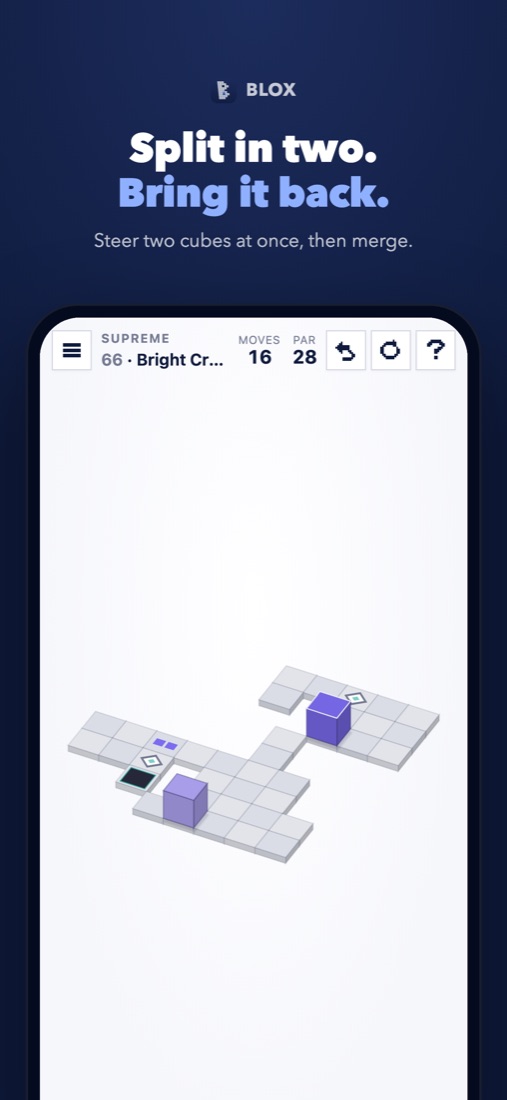
The split pad is marked with two small squares. Stand on it upright and your block splits into two separate cubes, placed elsewhere on the board. Move them one at a time (tap or Space to switch). When the two cubes sit side by side, they merge back into one block.
TIPA single cube is light: it never breaks a cracked tile, it can trigger touch pads but not press plates, and it can ride portals. Give each cube its own job before you merge them.
Scoring and par
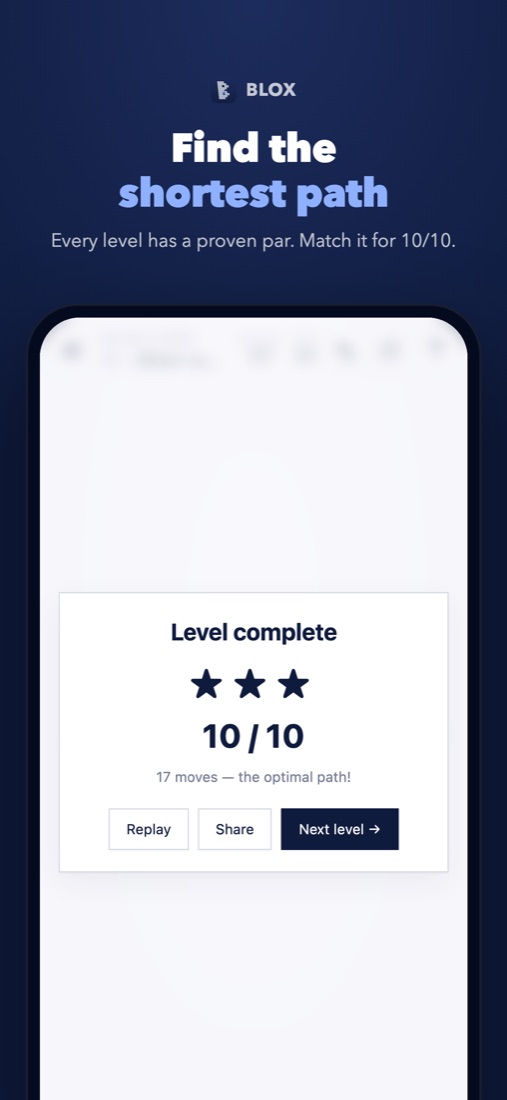
Every level is scored out of 10. Each level has a par: the shortest possible solution, proven by a computer search of every possible move. Solve a level in par moves and you get a perfect 10.
Use more moves and your score drops quickly. The formula is:
points = 10 × (par ÷ your moves)² × 0.9hints, rounded down, and never less than 1.
| Par | Your moves | Points |
|---|---|---|
| 10 | 10 | 10 |
| 10 | 11 | 8 |
| 10 | 12 | 6 |
| 10 | 15 | 4 |
| 10 | 25 | 1 |
Finishing always earns at least 1 point, so it is always worth completing a level, even the long way round. You can replay any level to improve your best score.
Hints, undo and restart
- Hints show you the next move of a shortest solution from where you are now. In the Easy tier hints are free. In every other tier, each hint multiplies your score by 0.9.
- Undo takes back your last move. Undone moves don't count against you: your score uses the moves in the path you actually finished with.
- Restart puts you back at the start with a fresh move count.
- In the Easy and Medium tiers, falling off the edge just rewinds one move so you can keep learning. From Hard upwards, a fall restarts the level.
Finding the shortest path
- Start at the end. You must finish standing on the hole. Ask which tiles you could stand on, or lie across, one move before that, and work backwards.
- Count the parity. The block alternates between standing and lying as it rolls along a line. If you keep arriving next to the hole lying down, you need one sideways roll somewhere to change your timing.
- Prefer upright travel for distance. Two rolls along a line move you three tiles. Sideways rolls only move one.
- Note every one-way tile. Crumbling floor, ice and conveyors limit where you can go back. Plan around them first.
- Check the move counter against par. If you are already past par, restart and try a different first move rather than pushing on.
- Use a hint as a lesson. In Easy, hints are free: use them to learn how the block likes to move, then try to beat the level again without help.
Tiers and unlocking
There are 80 levels in 8 tiers of 10: Easy, Medium, Hard, Extra Hard, Super, Ultra, Supreme and God-like. Finish 7 levels in a tier to open the next one. Guests can play the Easy tier; a free account (sign in with an emailed code) unlocks everything, keeps your progress safe and lets you join the weekly tournament and leagues.